Rotten, Decayed or Damaged Wood: Can It Be Saved with Epoxy Resin?
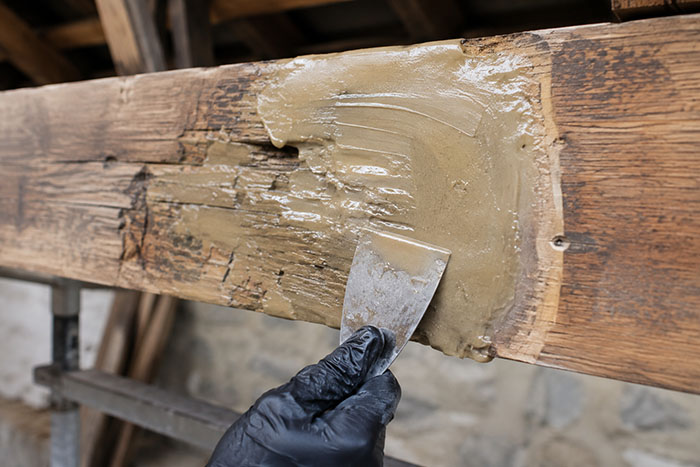
Moisture, water ingress, weather exposure, ageing… Over time, wood can crack, soften, crumble or lose some of its strength. However, damaged or locally rotten wood does not always need to be replaced.
When a sufficiently sound section of wood can be preserved, epoxy resin offers an effective solution for consolidating, reinforcing and restoring damaged areas.
WOODPOXY PLUS: An Epoxy Resin Designed for Wood
For bonding, laminating, reinforcing or restoring wood, it is important to use an epoxy system suitable for the substrate.
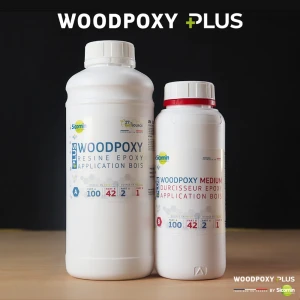
WOODPOXY PLUS is a bio-based epoxy resin specially developed for wood applications.
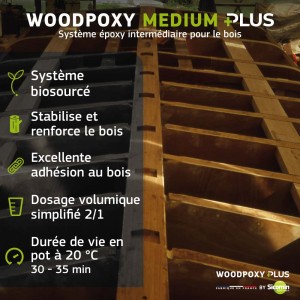
Its formulation provides excellent adhesion to wood and helps stabilise and reinforce the substrate.
WOODPOXY PLUS offers several key advantages:
- a bio-based epoxy system;
- excellent adhesion to wood;
- wood stabilisation and reinforcement;
- a simple 2:1 mixing ratio by volume;
- three hardeners to adapt the working time to the project;
- compatibility with Treecell, Silicell, MixFill and Wood Fill fillers.
Compatibility with different fillers makes it possible to adjust the viscosity and consistency of the mixture to suit the repair requirements.
WOODPOXY PLUS is manufactured in France. The resin and its hardeners contain between 27% and 41% bio-based carbon.
How Can You Identify Rotten or Severely Damaged Wood?
Before considering a repair, it is important to carefully assess the condition of the wood.
Wood damaged by moisture or ageing may show several signs:
- a soft or spongy surface;
- fibres that crumble easily;
- cracks or cavities;
- loss of material;
- unusual discolouration;
- areas that remain damp;
- reduced wood strength.
Visible surface deterioration may also conceal more extensive damage inside the wood.
It is therefore advisable to probe different areas of the wood to distinguish sound sections from those that are too weakened to be preserved.
This inspection is particularly important for beams, load-bearing elements or any other wooden component subjected to significant mechanical loads.
Before any restoration work, it is essential to identify and address the cause of the deterioration.
Repairing rotten wood without eliminating persistent water ingress will not provide a lasting solution.
Simply covering a rotten area with epoxy resin is not sufficient.
Completely deteriorated, crumbly or structurally unsound sections must be removed before carrying out the repair.
The area must also be thoroughly cleaned and the substrate properly prepared to ensure good adhesion.
The principle is therefore to preserve as much usable wood as possible, remove irreparable sections, then consolidate or rebuild the damaged area.
Proper surface preparation is essential for a durable repair.
How Can You Strengthen Weakened Wood with Epoxy Resin?
Once the irreparable sections have been removed and the substrate has been properly prepared, an epoxy system suitable for wood can be applied to the areas requiring restoration.
The resin penetrates the accessible wood fibres and creates a foundation for the next stages of the repair.
However, the amount of resin and the application method must be adapted to the depth and nature of the damage.
How Can You Rebuild a Missing Section of Wood?
Wood deterioration can sometimes leave significant holes after rotten or crumbly sections have been removed.
In this case, epoxy resin can be combined with different fillers to modify its consistency and adapt it to the work being carried out.
This produces a thickened mixture that can be used for certain filling, bonding or reconstruction applications.
For larger volumes, it may also be preferable to insert a sound piece of wood and bond it to the existing substrate rather than filling the entire cavity with resin alone.
The choice of method therefore depends on the geometry, the volume to be rebuilt and the mechanical loads applied to the component.
Which Wooden Components Can Be Restored with Epoxy Resin?
Many wooden components can be repaired or reinforced using epoxy resin, provided their condition allows it.
Joinery and Exterior Woodwork
Doors, windows, frames, shutters and other wooden joinery can gradually deteriorate when exposed to water and weather conditions.
Localised damage can sometimes be restored without replacing the entire component.
Beams and Structural Timber Components
The end of a beam or certain sections of a wooden structural component may be affected by water ingress.
However, whether a repair is possible depends directly on the condition of the structure and the loads to which it is subjected.
Furniture and Wooden Objects
Furniture, table legs, tabletops, decorative objects and antique wooden pieces may also develop cracks, breaks or areas of missing material.
Epoxy resin can be used for various bonding, consolidation or reconstruction operations.
Wood in Marine Applications
Wood is also widely used in boats and various marine fittings.
In this environment, which is particularly exposed to moisture, an epoxy resin suitable for wood can be used for bonding, laminating, reinforcing and protecting wooden components.
How Can You Prevent Repaired Wood from Rotting Again?
A successful repair should not simply address the visible consequences of deterioration.
It is essential to eliminate the underlying cause of the wood damage.
If moisture was caused by water ingress, the source must be eliminated. If water was accumulating around the component, drainage must be improved. Any damaged surface protection must also be restored.
To reduce the risk of further deterioration:
- identify the source of water ingress;
- ensure proper water drainage;
- avoid areas of permanent moisture;
- maintain protective wood coatings;
- regularly inspect repaired areas;
- apply a finish suitable for the component's environment.
Epoxy resin can contribute to a durable repair, but it does not eliminate the need to address the original cause of the wood damage.
FAQ – Repairing Rotten or Damaged Wood with Epoxy Resin
Can Rotten Wood Be Saved?
Yes, provided that a sufficiently sound and strong section of wood can still be preserved. Severely deteriorated areas must be removed before consolidating or rebuilding the component. If structural strength has been compromised, replacement may be necessary.
Which Resin Should You Use to Repair Damaged Wood?
It is best to use an epoxy system specifically designed for wood applications. WOODPOXY PLUS has been developed for bonding, laminating, filleting and coating wood, offering excellent adhesion and properties that help stabilise and reinforce the substrate.
How Can You Harden Wood That Has Become Soft?
First, you need to determine why the wood has become soft. Completely deteriorated sections or areas that have lost their cohesion must be removed. If enough sound wood remains, consolidation using a suitable epoxy system may be considered.
How Can You Repair Crumbling Wood?
Start by removing any loose or poorly bonded fibres and identifying the cause of the deterioration. The remaining area can then be consolidated and, if necessary, missing sections can be rebuilt using epoxy resin combined with an appropriate filler.
Can You Repair a Rotten Wooden Beam with Epoxy?
This depends on the extent of the deterioration and the structural role of the beam. Localised damage can sometimes be repaired, but a beam that has lost a significant amount of its strength requires a suitable structural assessment before any repair work is undertaken.
Do You Need to Remove All Rotten Wood Before Applying Resin?
Completely decomposed, crumbly or insufficiently cohesive sections must be removed. The aim is to expose a suitable substrate to which the repair material can properly adhere.
Can You Fill a Large Hole in Wood with Epoxy Resin?
Epoxy resin combined with suitable fillers can be used for certain reconstruction applications. However, for larger volumes, inserting and bonding a new piece of wood may be more appropriate than filling the entire cavity with resin.
Rotten or Damaged Wood: Repair Rather Than Replace Whenever Possible
Discovering a rotten, cracked or severely damaged section of wood does not necessarily mean that the entire component needs to be replaced.
When the damage remains localised, it may be possible to preserve the sound wood, remove irreparable areas, then consolidate and rebuild the damaged sections using a suitable epoxy system.
With its excellent adhesion to wood, three hardeners and compatibility with various fillers, WOODPOXY PLUS offers a versatile solution for bonding, laminating, consolidating and restoring wood.
However, the priority always remains the same: identify the cause of the deterioration before carrying out any repairs. Proper restoration combined with suitable protection can significantly extend the service life of the wooden component.