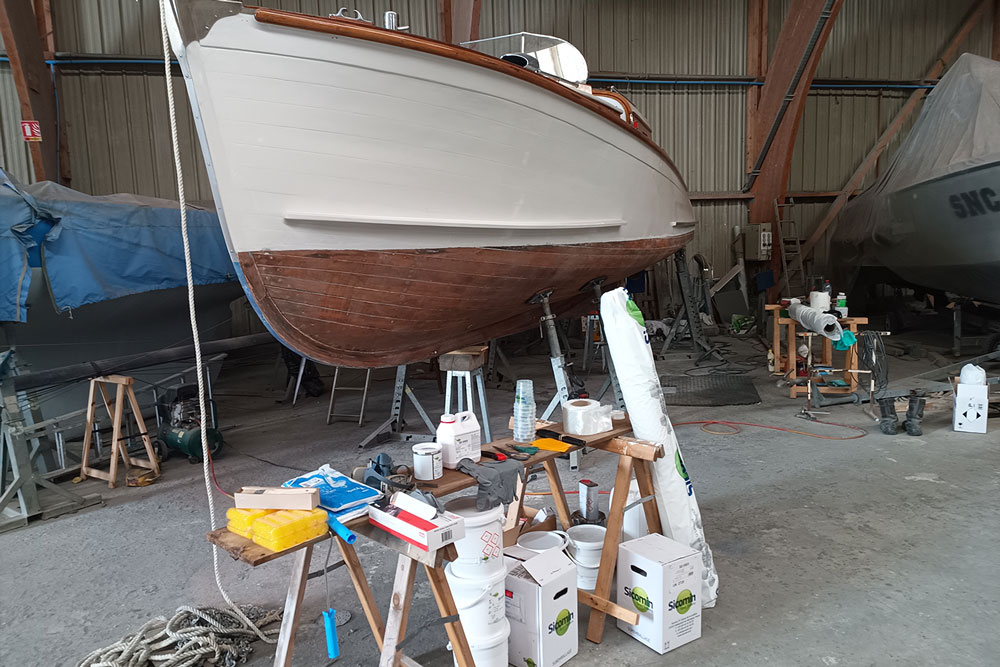
Laminating and Bonding wood

Every processing for wood epoxy system Laminating: SICOMIN wood epoxy system are use to laminating e-glass fiber on wood surfaces. Used on Hand lay up, Peeltex allow to obtaining a very good quality surface and laminating at 80% the sanding step before coating, bonding or second laminating step. Coating or epoxy varnish: Specifically developped for boat industry, SICOMIN epoxy varnishes can use with all wood surfaces, every pieces of boat and all sizes at room temperature. They cure at room temperature, and after application, the surface is bright and can be sanded even then. Bonding and fillet joints: This is the most common method of assembly in modern shipbuilding. A fillet joint is constituted by a loaded system applied in the angle formed by two panels to be assembled. This method is ideal when assembling parts that meet at different angles: partition at the shell, inner shell connecting bridge, chairs, chests ... Glulam beams: The technical advantages are obvious: - Improved mechanical properties: the adhesive joint is mechanically stronger than the lignified cells of the wood. Bond two pieces of wood, that is interposing a polymer adhering perfectly to the support, reconstituting between these two parts of the upper mechanical connections to the single piece of wood. The bonding is welding, the metallurgical sense. - The probability of rupture due to wood defects (knots) are reduced by their dispersions and by correction of adjacent lamellae. - The composite laminated enables designs optimized for example with blades of more resistant wood of area, low density wood in the center, multidirectional reinforcements ... everything is possible. - easy and accurate realization of complex shapes: Glulam enables plastic virtuosity. - The strips are cut or sliced into often cheaper wood pieces, smaller or falls. - Production of large lengths with relatively short strips. - Parts Realization curves small radii by sipes of small thicknesses. - Reliability over time: moisture resistance and bacteria improved by the glue joint, aging without alteration of technical performance. -  Aesthetic: Wedding of species and colors. Strip planking : The Strip planking is the fastest and easiest method of sandwich constructions. Relatively thick smooth a low density wood constitute the core of the sandwich. Asked outside couples to form a male model (sometimes female), they will then be laminated on both sides. Applications of wood epoxy system : - Boat industry - interior design, decoration - Others sectors: boating, leisure, industry, etc ...
Recherche produits

Processes

Use for

Show/hide more options

Mix viscosity at 20°C

Mix Color

Biosourcé

Pot life 100 g à 20 °C

There are 3 products.

Showing 1-3 of 3 item(s)
FAQ - Technical Support

Our answers to your most frequently asked questions

No, always use the resin and the hardener from the same system only. Our formulations are designed to be mixed together. If you do not use matching systems, you risk ruining both your mixture and your project.

Casting resin is designed for thick pours and transparency, while laminating resin is intended for impregnating fabrics (glass, carbon, etc.) in thin layers. They are not interchangeable.

Une résine époxy pour stratification et collage bois est une résine technique conçue pour imprégner des fibres ou assembler des pièces en bois avec une très forte adhérence. Elle pénètre dans les fibres du bois et crée une liaison solide et durable.

Elle est utilisée aussi bien pour renforcer des structures que pour réaliser des collages structurels, notamment en menuiserie, nautisme ou fabrication de pièces techniques.

C’est une solution polyvalente pour renforcer et assembler le bois efficacement.

La résine époxy offre une adhérence bien supérieure aux colles classiques. Elle pénètre profondément dans le bois, ce qui garantit une liaison très résistante.

Elle est particulièrement utile pour les assemblages soumis à des contraintes mécaniques ou à l’humidité. Elle permet aussi de coller des surfaces irrégulières.

Idéal pour des collages durables et résistants.

Il est déconseillé de coller du bois humide, car cela peut compromettre l’adhérence et la durabilité du collage.

La résine époxy fonctionne mieux sur un bois sec, ce qui permet une meilleure pénétration et une liaison plus solide.

Toujours privilégier un bois bien sec.

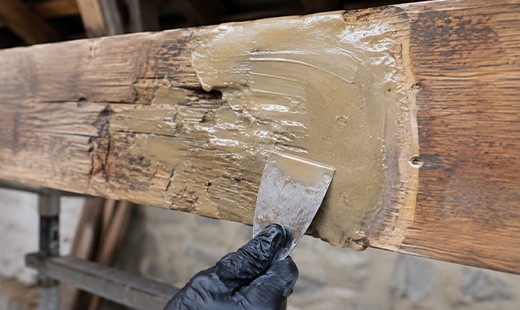
Oui, la résine époxy est idéale pour réparer le bois fissuré, pourri ou endommagé.

Elle permet de consolider la structure et de combler les zones abîmées, tout en assurant une bonne résistance mécanique.

Une solution efficace pour la rénovation bois.

Un collage époxy offre une résistance mécanique très élevée, souvent supérieure à celle du bois lui-même.

Il résiste aux contraintes, à l’humidité et aux variations de température, ce qui le rend adapté aux environnements exigeants.

Un choix fiable pour des assemblages durables.

Oui, la résine époxy permet de combler efficacement les fissures et les défauts du bois.

Elle peut être utilisée seule ou avec des charges pour obtenir une consistance adaptée.

Une solution durable pour réparer le bois.

Need personalized help?

contact us

Your achievements

To help you find inspiration